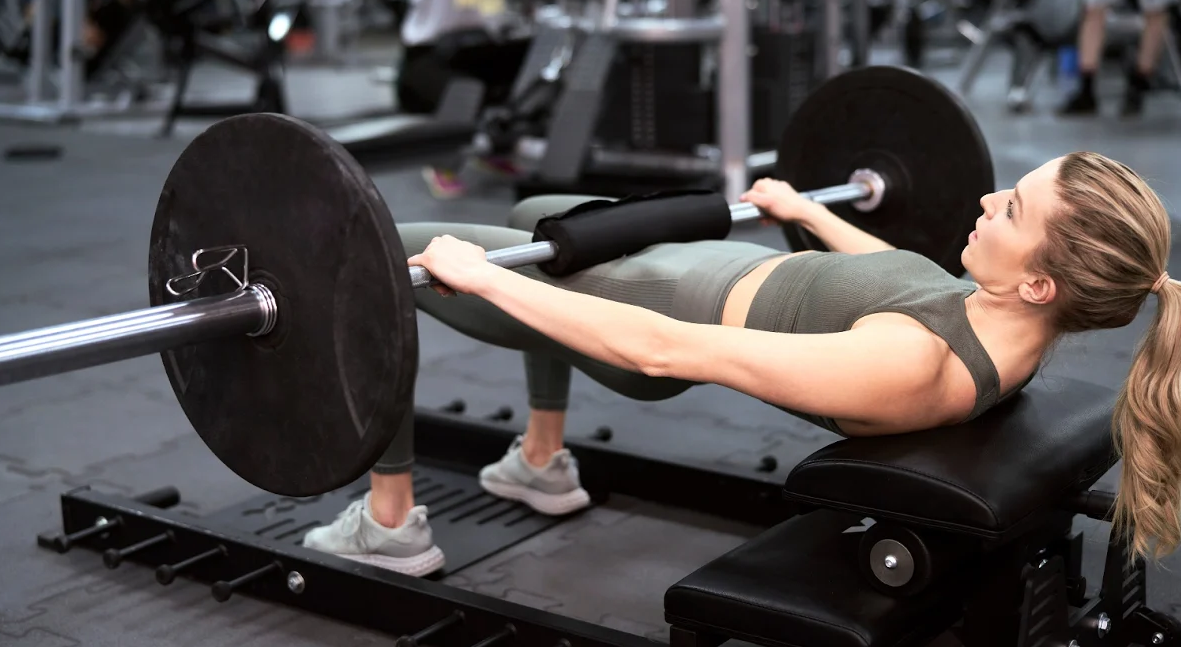
The hip thrust is a popular lower-body strength exercise, particularly among people looking to build stronger, more developed glutes. Unlike squats and lunges, which involve substantial movement at both the hips and knees, hip thrusts focus on hip extension. This allows the glutes to work against resistance without the same balance demands or degree of knee movement found in many standing exercises.
The movement looks simple, but small adjustments can make a noticeable difference. Bench height, foot placement, pelvic position, and trunk stability all affect how effectively you can drive through the hips.
Learning how to do hip thrusts correctly helps keep repetitions consistent, limits unnecessary lower-back movement, and provides a foundation for progressively heavier training.
What Is a Hip Thrust?
A hip thrust is a resistance exercise performed with the upper back supported against an elevated surface. Starting with the hips flexed and feet planted on the floor, the lifter extends the hips to raise the pelvis and torso.
The hip thrust exercise is commonly performed with a barbell resting across the front of the hips. Bodyweight, dumbbells, resistance bands, and dedicated machines are also suitable options.
Unlike a squat or lunge, the movement involves relatively little change in knee angle. Most of the visible motion comes from the hips, allowing the gluteus maximus to produce substantial force during extension.
In a conventional barbell hip thrust, resistance places considerable demands on the hip extensors near the top of the movement, where the glutes are relatively shortened. This differs from exercises such as Romanian deadlifts, which challenge the hip extensors at longer muscle lengths.
Hip thrusts are widely used in bodybuilding, general strength training, and athletic conditioning. Their primary purpose is to develop hip-extension strength, particularly in the gluteus maximus.
What Muscles Do Hip Thrusts Work?
The primary hip thrust muscles worked are the gluteal muscles, especially the gluteus maximus. Several other muscle groups contribute to hip extension, pelvic stability, and control of the knees and torso.
Gluteus maximus
The gluteus maximus is the main muscle responsible for extending the hips during a hip thrust. It generates much of the force needed to lift the pelvis and bring the torso into line with the thighs.
It also helps control the lowering phase. Because hip thrusts accommodate substantial external resistance, they can effectively build strength and muscle in the gluteus maximus.
Gluteus medius and gluteus minimus
These smaller gluteal muscles help stabilize the pelvis and control the position of the thigh bones. Their contribution becomes particularly important during single-leg variations, when the pelvis must remain level without support from the opposite foot.
However, conventional hip thrusts are not primarily hip-abduction exercises. Lateral band walks and cable abductions train that function more directly.
Hamstrings
The hamstrings assist with hip extension, although their contribution depends partly on knee position.
Most hamstring muscles cross both the hip and knee joints. Because the knees remain bent during hip thrusts, these muscles operate under different length and force conditions than during Romanian deadlifts.
They still contribute to the movement, but the gluteus maximus performs much of the hip-extension work.
Quadriceps
The quadriceps contribute to knee-extension torque and help maintain knee position as force passes through the feet.
Their involvement changes with foot placement, but the knees move relatively little during a conventional hip thrust. As a result, the exercise is not a substitute for squats, leg presses, or other movements that train knee extension through a larger range.
Core and spinal stabilizers
The abdominal muscles and spinal stabilizers maintain trunk position while the hips move.
Their main role is to resist excessive spinal movement, particularly lumbar extension near the top of the repetition. Keeping the rib cage and pelvis controlled helps prevent the lower back from compensating for incomplete hip extension.
How to Perform a Hip Thrust Step by Step
Proper hip thrust form begins with a stable setup. The bench must remain secure, and the feet should provide a firm base throughout each repetition.
Beginners can learn the movement using bodyweight before adding resistance.
Starting Position and Equipment Setup
Choose a sturdy bench or platform that will not slide under pressure. A standard weight bench may work, provided its height allows comfortable upper-back support.
- Sit on the floor with your back facing the bench and your knees bent.
- Position the lower portion of your shoulder blades against the bench edge. Adjust the contact point according to your proportions and the bench height.
- Place your feet approximately hip-width to shoulder-width apart, with both soles flat on the floor.
- Adjust your foot position so your shins are close to vertical near the top of the movement.
- Keep your head aligned with your torso rather than throwing it backward.
For a barbell hip thrust, roll the bar over your legs and position it across the crease at the front of your hips. Use a thick bar pad to distribute pressure across the pelvis.
The bar should not press directly into your abdomen. Hold it securely with both hands to prevent rolling.
Before lifting, check that the bench is stable, the weight plates have enough clearance, and your feet have adequate traction. Test the setup with a light load before attempting heavier repetitions.
Hip Extension and Proper Form
The lifting motion should come primarily from the hips, with the torso remaining controlled.
- Brace your abdominal muscles and keep your ribs from flaring upward.
- Press through your feet while maintaining contact between your heels and the floor.
- Extend your hips, raising the pelvis and torso together in a smooth motion.
- Continue until your torso and thighs are approximately aligned, without arching your lower back.
- Briefly hold the top position while maintaining glute tension.
- Lower your hips under control before beginning the next repetition.
At the top, the knees are typically bent near a right angle, although the exact position depends on individual proportions.
Keep your knees tracking in roughly the same direction as your toes. Avoid forcing them excessively outward or allowing them to collapse inward.
Your neck should follow the torso naturally. Looking forward or slightly downward is acceptable, provided you do not force your chin against your chest.
Breathing and tempo
Inhale and establish abdominal tension before lifting. With moderate resistance, you can exhale during the effort while maintaining trunk stability.
Heavier lifting sometimes involves a brief breath hold to increase abdominal pressure, but this technique is not necessary for everyone. People with cardiovascular conditions should seek appropriate guidance before using deliberate breath-holding strategies.
Lift deliberately and lower the weight slightly more slowly if needed to maintain control. A brief pause at the top can help eliminate momentum.
How high should the hips rise?
The goal is full hip extension within a comfortable range, not maximum possible pelvic height.
At the top, your torso and thighs should approach a straight line. If raising the hips farther requires arching the lumbar spine, you have moved beyond the intended endpoint.
A slight posterior pelvic tilt may help lifters who tend to overextend their lower backs. Avoid exaggerating this adjustment into a forceful curling motion.
Benefits of Hip Thrusts
The main hip thrust benefits involve glute strength, muscle development, and the ability to train hip extension with adjustable resistance.
Glute strength and hypertrophy
Hip thrusts allow the gluteus maximus to work against substantial resistance. With sufficient effort, training volume, and progressive overload, they can contribute to increased muscle strength and size.
They also provide a way to add glute-focused work without relying exclusively on squats or deadlifts.
However, hip thrusts are not automatically superior to other glute exercises. Squats, split squats, and Romanian deadlifts challenge the muscles through different joint positions and loading conditions.
Hip-extension strength
Hip extension contributes to everyday activities such as standing up and climbing stairs. It is also important in sprinting, jumping, and other athletic movements.
Strengthening the hip extensors can improve force production in this movement pattern. Whether that improvement translates into better athletic performance depends on the sport and the overall training program.
Hip thrusts can supplement athletic strength development but cannot replace sprinting, jumping, or sport-specific practice.
Reduced balance demands
With the upper back supported and both feet planted, conventional hip thrusts generally require less balance than lunges, step-ups, or single-leg squats.
This allows lifters to concentrate on producing force through the hips rather than maintaining an upright position.
Adjustable resistance
Hip thrusts can be performed with bodyweight, dumbbells, resistance bands, barbells, or machines.
These options accommodate different experience levels and training environments. Resistance can be increased gradually as strength improves.
Complementary lower-body training
Hip thrusts fit well into programs that already include squats, hinges, and unilateral exercises.
For example, squats can provide substantial training for both the quadriceps and glutes, Romanian deadlifts challenge the posterior chain at longer muscle lengths, and hip thrusts add focused hip-extension work near full extension.
Together, these movements expose the lower-body muscles to a broader range of demands.
Common Hip Thrust Mistakes to Avoid
Most technique problems involve unstable equipment, unsuitable foot placement, excessive spinal movement, or using more resistance than can be controlled.
Overarching the lower back
Excessive lumbar extension often occurs when a lifter tries to push the hips higher after reaching full hip extension.
Keep your abdominal muscles engaged and stop when the torso and thighs are approximately aligned. If the ribs flare upward or the lower back arches noticeably, reduce the range of motion or resistance.
Placing the feet too far forward
When the feet are excessively far from the hips, the knees become more extended at the top. This may increase hamstring involvement and make the movement uncomfortable for some lifters.
Move your feet slightly closer until your shins approach vertical near full hip extension.
Treat this as a starting guideline rather than a strict requirement.
Placing the feet too close
Feet positioned too close to the hips create greater knee flexion and may cause discomfort at the front of the knees.
Move your feet forward in small increments until you can press firmly through the floor without discomfort.
Pushing through the toes
Allowing the heels to lift can reduce stability and change how force is distributed through the feet.
Keep the entire foot in contact with the floor. There is no need to deliberately lift your toes or shift all your weight onto your heels.
Using momentum
Bouncing out of the bottom position or throwing the hips upward makes it harder to control the resistance.
With heavy weights, sudden movements can also shift the bar or destabilize the bench.
Use a deliberate lifting motion and lower the weight without dropping your hips.
Choosing an unsuitable bench
A bench that is too high may place the upper back in an awkward position. One that is too low can limit the available range of motion.
An unsecured bench may also slide backward under pressure.
Choose a stable support that fits your proportions. Dedicated hip thrust benches and machines may offer a more comfortable setup.
Loading too heavily too soon
Excessive resistance often leads to shortened repetitions, poor pelvic control, or unwanted spinal movement.
Increase the weight only when you can complete the intended range with consistent technique.
Hip Thrust Variations for Different Fitness Levels
Different hip thrust variations change the resistance, equipment requirements, and stability demands. The appropriate choice depends on training experience and available equipment.
Bodyweight hip thrust
Bodyweight hip thrusts are a practical starting point for beginners.
Rest your upper back against a bench and perform the movement without external resistance. Focus on stable foot contact and controlled hip extension.
This variation also works as a warm-up before heavier sets.
Dumbbell hip thrust
A dumbbell provides an intermediate option between bodyweight and barbell training.
Position it horizontally across the front of your hips and hold it securely. Padding may improve comfort.
This version is convenient for home workouts, although large dumbbells can become awkward to position.
Barbell hip thrust
The barbell hip thrust accommodates relatively heavy resistance and allows precise weight adjustments.
Place a padded bar across the hip crease, keep it centered, and secure the plates with collars.
As resistance increases, maintaining a stable bench and consistent bar position becomes particularly important.
Resistance band hip thrust
Resistance bands can provide the main hip-extension load or supplement free weights.
When secured across the hips and anchored beneath the feet or to a stable platform, a band produces increasing tension as the hips rise.
A small loop band around the thighs serves a different purpose. It adds resistance to hip abduction and can encourage knee control, but it does not replace the main resistance used to extend the hips.
Single-leg hip thrust
Single-leg hip thrusts increase the relative demand on the working leg and introduce greater pelvic stability requirements.
Begin with both feet planted, then lift one foot. Drive through the supporting leg while keeping the pelvis level and preventing torso rotation.
Start with bodyweight and a smaller range of motion if necessary.
Machine hip thrust
Dedicated hip thrust machines provide a fixed support surface and a resistance mechanism designed for hip extension.
They eliminate the need to balance a free barbell across the pelvis and often reduce setup time.
Machine designs vary in pad placement, movement path, and resistance curve. Adjust the equipment to your proportions before adding substantial weight.
Sets, repetitions, and progression
For general muscle development, two to four working sets of approximately 6–15 repetitions provide a practical starting range.
Beginners can start with two or three sets of 8–12 repetitions, leaving several repetitions in reserve while learning the technique.
More experienced lifters may use heavier sets with fewer repetitions for strength development or moderate loads for additional hypertrophy work.
Once every planned repetition can be completed without losing pelvic control or shortening the movement, increase the weight slightly or add repetitions.
Rest long enough to maintain performance across sets. Heavier efforts generally require longer recovery than lighter accessory work.
Hip Thrust vs Glute Bridge
Hip thrusts and glute bridges both train hip extension, but their starting positions create different movement characteristics.
In a conventional glute bridge, the shoulders and upper back remain on the floor. During a hip thrust, the upper back rests against an elevated support.
Range of motion
Hip thrusts generally allow a larger range of hip motion because the elevated upper-body position provides more room for the pelvis to descend.
Glute bridges begin with the torso supported by the floor, limiting how far the hips can move downward.
The useful range depends on individual anatomy, mobility, and control.
Loading potential
Hip thrusts are commonly performed with substantial external resistance. The elevated setup provides room for the pelvis to move while supporting a barbell across the hips.
Glute bridges can also be loaded with barbells, dumbbells, or bands. Their shorter range of motion changes the training stimulus but does not automatically make them less effective.
Lifting more weight does not necessarily produce greater muscle growth. Effort, resistance, range of motion, and total training volume all matter.
Setup and accessibility
Glute bridges require minimal equipment and can be performed directly on the floor.
They are often easier for beginners because there is no bench to position or stabilize.
Hip thrusts require more preparation but offer a larger range of motion and additional loading options.
Which exercise is better?
For beginners learning hip-extension control, the glute bridge is often the simpler choice.
Lifters seeking a larger range of motion and substantial external resistance may find hip thrusts more practical.
Both exercises can develop the glutes. The better option depends on training goals, equipment, and comfort.
FAQ
How many hip thrusts should beginners do?
Beginners can start with two or three sets of 8–12 controlled repetitions using bodyweight or light resistance.
Focus on stable foot placement, smooth hip extension, and consistent technique before increasing the load.
Should you feel hip thrusts in your glutes?
The glutes should contribute substantially to the movement, but a strong burning sensation is not required for an effective set.
Muscle soreness is also an unreliable measure of training quality.
If you consistently feel excessive effort or discomfort in your lower back, review your pelvic position, foot placement, and resistance.
Can hip thrusts replace squats?
Hip thrusts can develop glute strength and muscle size, but they do not reproduce all the movement demands of squats.
Squats involve substantial hip and knee extension, providing more direct training for the quadriceps through a larger knee range of motion.
Both exercises can be useful for balanced lower-body development.
Are hip thrusts safe for the lower back?
Hip thrusts are generally well tolerated when performed with suitable resistance, stable equipment, and controlled technique.
Avoid excessive lumbar extension and reduce the load if you cannot maintain trunk position.
Persistent pain, sharp discomfort, or symptoms radiating into the legs should be assessed by a qualified healthcare professional.
How often should you do hip thrusts?
Hip thrusts can be trained once to three times per week, depending on intensity, total glute training volume, and recovery.
Two weekly sessions are a reasonable starting point for many recreational lifters. Additional sessions may be useful when training volume is distributed appropriately.
Do hip thrusts build bigger glutes?
Hip thrusts can contribute to gluteal hypertrophy when performed with sufficient resistance, effort, and training volume.
Progressive overload supports continued development, while nutrition and recovery influence the results.
Other exercises, including squats, split squats, and Romanian deadlifts, can also produce substantial glute growth.