Dumbbells are among the most versatile tools for strength training. A single pair can work the arms, shoulders, chest, back, legs, and core without requiring weight machines or much floor space. They fit easily into home workouts and gym routines, whether the goal is to build muscle, increase strength, or become more comfortable lifting weights.
For beginners, the challenge is often deciding where to start. There are dozens of possible exercises, but choosing suitable weights and learning proper technique matter more than the number of movements in a routine. Heavy dumbbells can make exercises difficult to control, while weights that offer too little resistance may eventually limit progress.
An effective beginner routine doesn’t have to be complicated. A handful of exercises covering the major muscle groups, performed consistently with appropriate resistance, provides a foundation for long-term strength development.
What Are Dumbbells and What Are They Used For?
A dumbbell is a free weight consisting of a short handle with weight at each end. Unlike a barbell, which is generally held with both hands, dumbbells allow each arm to move independently. They can also be used individually for exercises requiring only one weight.
Dumbbells are primarily used for resistance training. Curls, presses, rows, squats, and lunges challenge different muscle groups depending on the movement and how the weight is held.
They work for both isolation exercises, which emphasize particular muscles, and compound movements involving several joints. Many exercises can be performed standing, seated, or lying on a bench or floor.
Independent arm movement is another advantage. During a barbell press, both hands control the same implement. With dumbbells, each arm handles its own load, making differences in strength and coordination easier to notice.
Dumbbells are not necessarily superior to machines or barbells. Machines can provide additional support and a guided movement path, while barbells are particularly useful for handling heavier combined loads. Dumbbells offer flexibility, especially when learning fundamental strength-training movements.
Types of Dumbbells and Their Differences
Most dumbbells fall into two categories: fixed and adjustable. Both can support effective strength training, but they differ in convenience, storage requirements, and cost.
Fixed Dumbbells
Fixed dumbbells have a permanent weight. They are common in commercial gyms, where racks hold multiple pairs arranged from light to heavy.
Their biggest advantage is convenience. There are no plates or adjustment mechanisms to handle between exercises. Switching from a lighter shoulder movement to a heavier leg exercise simply means picking up another pair.
Fixed dumbbells come in several finishes:
- Rubber-coated dumbbells have metal cores with rubber-covered heads that help reduce noise and protect flooring.
- Neoprene dumbbells feature a softer outer coating and are commonly available in lighter weights for home workouts and fitness classes.
- Cast-iron dumbbells are durable and compact, although they can damage unprotected floors.
- Urethane-coated dumbbells resist wear and are popular in commercial gyms, but usually cost more.
The main drawbacks are storage space and expense. Building a collection of fixed dumbbells becomes increasingly costly as heavier weights are needed.
Adjustable Dumbbells
Adjustable dumbbells provide several resistance levels using a single pair of handles. The two most common designs are plate-loaded and selectorized.
Plate-loaded dumbbells use removable weight plates secured with collars. They are relatively simple to maintain and can be economical, particularly when compatible plates are already available. Changing weights takes longer, and the collars must be secured before lifting.
Selectorized models use a dial, pin, or similar mechanism to select the desired resistance. Unused plates remain in a storage cradle, allowing quicker adjustments.
These systems save space but have trade-offs. Selectorized dumbbells generally cost more upfront, contain moving parts, and may be damaged if dropped. Their larger dimensions can also interfere with certain movements.
Weight increments deserve attention. A model with 2.5-pound adjustments offers more flexibility for smaller upper-body exercises than one that increases only in 5-pound steps.
Which Type Is Better for Beginners?
Neither design has an inherent advantage for muscle development. Training results depend on resistance, technique, and progression rather than the construction of the dumbbell.
Adjustable dumbbells are practical for small home gyms because one pair covers several weight levels. Fixed dumbbells are convenient when durability and quick transitions matter more than storage space.
Handle comfort, grip texture, balance, and secure weight attachments are worth checking before purchasing either type.
Benefits of Training With Dumbbells
Regular dumbbell training can improve muscular strength, support muscle growth, and develop physical abilities used in everyday activities. Results depend on training effort, exercise selection, recovery, and consistency.
Building Strength and Muscle
Resistance training challenges muscles by making them produce force against an external load. With sufficiently demanding exercise and adequate recovery, muscles can grow stronger and larger over time.
Dumbbells can train nearly every major muscle group. Presses work the chest, shoulders, and triceps, while rows strengthen the back and elbow flexors. Squats, lunges, and hip-hinge exercises target the lower body.
Muscle growth is possible across a broad range of repetitions when sets are challenging enough. Beginners do not need maximum loads to make progress.
Improving Coordination and Body Control
Free-weight exercises require control throughout the movement. During a standing dumbbell press, the shoulders and arms lift the weights while the trunk helps maintain stability.
Unilateral exercises, such as single-arm rows and split squats, place additional demands on coordination. They also make strength differences between the left and right sides more noticeable.
These movements do not automatically eliminate muscular imbalances, but they allow each side to be trained separately.
Supporting Everyday Movement
Many dumbbell exercises develop strength through familiar movement patterns. Squats involve coordinated hip and knee movement, rows build pulling strength, and loaded carries challenge grip and trunk stability.
Stronger muscles can make carrying groceries, lifting household objects, and climbing stairs easier.
Regular resistance training can also help maintain bone health and, under suitable training conditions, improve bone mineral density. The response varies with age, training intensity, exercise selection, and individual health.
Making Strength Training More Accessible
Dumbbells require little space and work well for short sessions. Beginners can start with limited equipment and expand their options as strength improves.
Exercises can also be modified to match current ability. Someone struggling with a standing overhead press may find a seated variation easier to control. A goblet squat allows a beginner to practice squatting while holding one weight close to the chest.
How to Choose the Right Dumbbell Weight
There is no universal starting weight for beginners. Strength varies between individuals and exercises, and the resistance suitable for a squat may be far too heavy for a lateral raise.
Choosing weights separately for each movement is more practical than using the same pair throughout a workout.
Start With the Exercise, Not a Fixed Number
Larger muscle groups generally handle heavier loads than smaller ones, although experience, mobility, and technique also affect lifting capacity.
The following ranges are illustrative starting points that beginners might test during their first sessions.
| Exercise | Initial weight to try |
| Biceps curl | 5–10 lb per dumbbell |
| Lateral raise | 2–5 lb per dumbbell |
| Shoulder press | 5–10 lb per dumbbell |
| One-arm row | 10–20 lb |
| Goblet squat | 10–20 lb, held with both hands |
| Romanian deadlift | 10–20 lb per dumbbell |
These figures are not strength standards or minimum requirements. Some beginners will need lighter weights, while others can safely start heavier. Choose a weight you can control throughout every repetition.
Use Repetitions to Test the Weight
A practical starting method is to perform 8–12 controlled repetitions with a manageable dumbbell.
If the final repetitions require noticeable effort but technique remains steady, the weight may be suitable. If all 12 feel easy, try slightly more resistance. If completing eight requires swinging, twisting, or compensating with other muscles, reduce the load.
During early sessions, beginners can aim to finish most sets feeling capable of completing another two or three repetitions with proper technique. This is known as leaving repetitions in reserve.
It allows sets to be challenging without taking every exercise to muscular failure.
Know When to Increase the Weight
Progressive overload means gradually increasing training demands as strength improves.
Adding weight is one method, but progress can also come from completing more repetitions, performing additional sets, or progressing to more challenging variations.
For example, someone performing three sets of eight dumbbell rows might gradually work toward three sets of twelve. Once all sets feel manageable with consistent technique, a small weight increase is reasonable.
Smaller increments are particularly useful for upper-body exercises. Moving from a 5-pound dumbbell to a 10-pound dumbbell doubles the resistance, potentially making the jump excessive for lateral raises or curls.
Consider the Weight of Both Dumbbells
Dumbbell labels normally show the weight of one dumbbell, not the combined weight of a pair.
Holding two 15-pound dumbbells means lifting 30 pounds of external resistance. A goblet squat performed with one 15-pound dumbbell uses only 15 pounds.
When recording workouts, note whether an exercise uses one or two dumbbells. A simple training log makes progression easier to track.
Best Dumbbell Exercises for Beginners
A balanced beginner routine should include pushing, pulling, squatting, hip hinging, and trunk-stability movements.
The exercises below cover these patterns without complicated equipment. Beginners can start with one or two sets per movement and gradually build toward two or three sets.
Most dumbbell exercises work well for 8–12 repetitions, although isolation movements may use higher repetitions and loaded carries are better measured by time.
Upper Body Dumbbell Exercises
- Dumbbell Floor Press
The dumbbell floor press works the chest, triceps, and front deltoids. It is a useful alternative to a bench press when no workout bench is available.
Lie on the floor with the knees bent and feet planted. Hold a dumbbell in each hand, keeping the elbows at a comfortable angle from the torso.
Press the weights upward until the arms are straight, without abruptly snapping the elbows. Lower them under control until the upper arms gently contact the floor.
The floor limits the bottom range of motion compared with a conventional bench press.
Recommended volume: 2–3 sets of 8–12 repetitions.
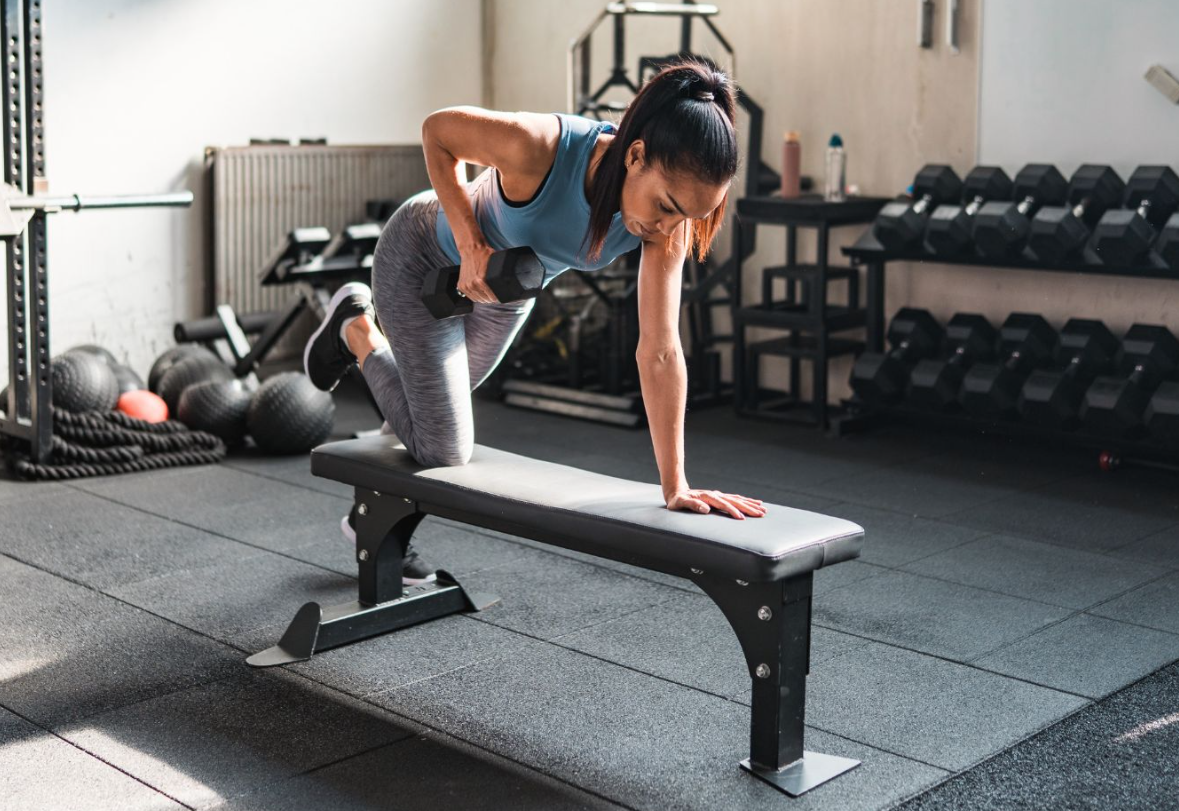
- One-Arm Dumbbell Row
The one-arm row develops the latissimus dorsi, upper-back muscles, and elbow flexors.
Place one hand on a sturdy bench or stable surface. Step into a staggered stance and hinge at the hips, keeping the torso steady. Hold a dumbbell in the free hand with the arm extended toward the floor.
Pull the weight toward the hip without excessively rotating the shoulders. Lower it slowly, avoiding momentum from the lower back.
Recommended volume: 2–3 sets of 8–12 repetitions per arm.
- Dumbbell Shoulder Press
The shoulder press primarily targets the deltoids and triceps.
Sit upright on a stable bench or chair, using back support if needed. Hold the dumbbells near shoulder height with the palms facing forward or slightly inward.
Press the weights overhead along a comfortable path. Keep the torso stable rather than arching the lower back to compensate for excessive resistance.
Lower the dumbbells to approximately shoulder level.
Recommended volume: 2 sets of 8–12 repetitions.
- Dumbbell Biceps Curl
Biceps curls strengthen the elbow flexors, particularly the biceps brachii.
Stand with a dumbbell in each hand and the arms at the sides. Bend the elbows to raise the weights while keeping the upper arms relatively still.
Lower the dumbbells slowly without swinging the torso.
Keeping the palms facing inward creates a hammer curl variation, which places greater emphasis on the brachialis and brachioradialis.
Recommended volume: 2 sets of 10–15 repetitions.
- Dumbbell Lateral Raise
Lateral raises primarily train the middle portion of the deltoid muscles.
Stand upright with light dumbbells at the sides. Maintain a slight bend in the elbows and raise the arms outward until they approach shoulder height.
Lower the weights under control, avoiding excessive shrugging or swinging.
Because the arms create a long lever, even light dumbbells can provide substantial resistance.
Recommended volume: 2 sets of 10–15 repetitions.
Lower Body and Core Exercises
- Goblet Squat
The goblet squat develops the quadriceps and glutes while challenging trunk stability.
Hold one dumbbell vertically near the chest with both hands. Stand with the feet approximately shoulder-width apart, adjusting the stance for comfort.
Bend the hips and knees to lower into a squat. Keep the feet planted and allow the knees to track naturally in the direction of the toes.
Descend as far as balance and control allow, then push through the feet to stand.
Recommended volume: 2–3 sets of 8–12 repetitions.
- Dumbbell Romanian Deadlift
The Romanian deadlift emphasizes the hamstrings and glutes while requiring the muscles surrounding the spine to stabilize the torso.
Stand with a dumbbell in each hand, holding the weights in front of the thighs. Keep the knees slightly bent.
Push the hips backward and allow the torso to lean forward while maintaining a stable spinal position. Keep the dumbbells close to the legs.
Lower the weights as far as you can comfortably hinge without rounding the lower back. Return to standing by extending the hips.
Keep the focus on pushing your hips back, not bending your knees into a squat.
Recommended volume: 2–3 sets of 8–12 repetitions.
- Dumbbell Reverse Lunge
Reverse lunges train the quadriceps and glutes while developing single-leg stability.
Stand upright with a dumbbell in each hand. Beginners who struggle with balance can start without weights.
Step backward with one leg and bend both knees to lower the body. Keep the front foot planted and the torso controlled.
Push through the front foot to return to standing. Alternate legs or complete the repetitions on one side before switching.
Choose a comfortable step length that allows stable movement.
Recommended volume: 2 sets of 8–10 repetitions per leg.
- Dumbbell Farmer’s Carry
The farmer’s carry develops grip strength and challenges the shoulders and trunk to maintain posture while walking.
Hold a dumbbell in each hand with the arms extended at the sides. Stand tall and walk forward at a steady pace.
Keep the shoulders level, avoid leaning sideways, and breathe naturally.
Choose weights that can be held securely without losing posture. Stop if grip strength or walking control deteriorates.
Recommended volume: 2–3 carries of 20–40 seconds.
- Dumbbell Dead Bug
The dead bug is a trunk-stability exercise that can be performed with one light dumbbell.
Lie on the back with the hips and knees bent to approximately 90 degrees, keeping the knees above the hips. Hold a light dumbbell with both hands directly above the chest.
Keep the ribs and pelvis steady while slowly extending one leg toward the floor. Avoid allowing the lower back to arch.
Return the leg and repeat on the opposite side. The dumbbell remains stationary throughout the exercise.
If trunk control becomes difficult, perform the movement without additional weight.
Recommended volume: 2 sets of 6–10 repetitions per leg.
Full-Body Dumbbell Workout for Beginners
Beginners do not need to perform every exercise listed above. A routine built around six movements can train the major muscle groups without unnecessary fatigue.
The following dumbbell workout is suitable for two or three nonconsecutive sessions per week.
| Exercise | Sets | Repetitions |
| Goblet squat | 2 | 8–12 |
| Dumbbell Romanian deadlift | 2 | 8–12 |
| Dumbbell floor press | 2 | 8–12 |
| One-arm dumbbell row | 2 | 8–12 per arm |
| Dumbbell shoulder press | 2 | 8–12 |
| Farmer’s carry | 2 | 20–30 seconds |
Start with five to ten minutes of light activity and movement-specific warm-up exercises. Practice unfamiliar movements with lighter weights before challenging sets.
Rest approximately 60–120 seconds between sets, allowing more recovery when needed. Perform the exercises in the order shown rather than rushing through them as a circuit.
The floor press and shoulder press both involve the front deltoids and triceps. Beginners who find the combined pressing volume excessive can temporarily perform only one.
Curls, lateral raises, reverse lunges, and dead bugs can be introduced as accessories or alternatives once the basic routine becomes manageable.
Two weekly sessions can be enough to begin developing strength. A third may be added when recovery allows, leaving at least one day between demanding full-body workouts.
Some soreness is common after unfamiliar exercise, but it is not a measure of workout effectiveness. Sharp pain, persistent joint discomfort, or dizziness are reasons to stop and reassess the activity.
Common Dumbbell Training Mistakes
Dumbbells are accessible to beginners, but poor exercise habits can interfere with progress.
- Choosing weights based on appearance rather than ability. A dumbbell that looks light may still be too heavy for a particular movement. Select resistance according to the repetitions you can complete with proper technique.
- Using momentum to finish repetitions. Swinging the torso during curls or jerking the shoulders during raises reduces control. If momentum becomes necessary, lower the weight or end the set.
- Using an unnecessarily short range of motion. Partial repetitions have legitimate training applications, but beginners should first learn a comfortable, controlled range before experimenting with specialized variations.
- Holding the breath throughout a set. Exhaling during the lifting phase and inhaling during the lowering phase is a practical starting approach. Deliberate breath-holding techniques used in heavy lifting are unnecessary for most basic beginner exercises.
- Increasing resistance too quickly. Jumping to much heavier dumbbells can disrupt technique, especially during smaller upper-body movements. Gradual increases make progression easier to manage.
- Ignoring recovery. Training the same muscle groups intensely every day can interfere with performance. Beginners generally benefit from recovery time between demanding sessions.
- Changing exercises too frequently. Constantly replacing movements makes progress difficult to measure. Repeating a manageable selection for several weeks helps develop coordination.
- Skipping lower-body exercises. Dumbbell workouts are often associated with curls and shoulder movements, but squats, lunges, and hip hinges are important parts of a balanced strength program.
Recording weights, repetitions, and perceived effort after each workout makes it easier to recognize progress and identify when adjustments are needed.
FAQ
What dumbbell weight should a beginner start with?
Starting weights depend on the exercise and individual strength. A pair of 5–10-pound dumbbells may suit some beginners for basic upper-body movements, while lower-body exercises often allow heavier resistance. Test the weight with 8–12 controlled repetitions and adjust as needed.
Can you build muscle with dumbbells alone?
Yes. Dumbbells can provide enough resistance to build muscle when training is consistent and sufficiently challenging. Recovery and nutrition also influence results. As strength improves, heavier dumbbells or more demanding exercise variations may be needed.
How often should beginners do dumbbell workouts?
Two or three full-body sessions per week are a practical starting point. Scheduling workouts on nonconsecutive days allows recovery between demanding sessions. Frequency can increase as experience and recovery capacity improve.
Are adjustable dumbbells as effective as fixed dumbbells?
Yes. Both can support comparable strength and muscle development when they provide suitable resistance and allow safe movement. Adjustable dumbbells save space, while fixed models generally offer faster weight changes and fewer mechanical components.
Is a 20-minute dumbbell workout enough?
A 20-minute session can be productive for beginners, particularly when it includes compound exercises and appropriately challenging sets. Longer workouts allow more training volume, but short sessions can still contribute to strength development when performed consistently.